
Meta ads campaign structure: how to set it up
In short
Meta ads have three levels: the campaign sets the objective, the ad set defines audience, placements, budget and schedule, and the ad holds format and creative (Meta Business Help). A structure that works keeps one objective per campaign, only as many ad sets as the budget can feed, several creatives inside each ad set and names that follow one pattern.
The three levels
- Campaign: here you choose the objective, the overall result you want, and the buying type. Most advertisers use the auction. A campaign contains one or more ad sets.
- Ad set: audience, placements, budget and schedule. All ads in an ad set share these settings.
- Ad: format (single image or video, carousel or collection), creative with images, videos, text and links, and the Facebook Page and Instagram account the ad runs under.
The hierarchy lets you test different audiences, budgets and creatives under one objective (Meta Business Help).
Step 1: Choose the objective
Ads Manager offers six objectives (Meta Business Help):
- Awareness: reach the largest number of people likely to remember your ad.
- Traffic: send people to a destination, such as your website, app or Facebook Page.
- Engagement: find people likely to interact with your business online, send a message or take an action on your ad or Page.
- Leads: collect leads through messages, phone calls or sign-ups.
- App promotion: get people to install your app or take an action in it.
- Sales: find people likely to buy; you can also optimize for steps such as adding to cart.
Start from the outcome your business needs, not from the metric that is cheapest to buy. If you sell online, the objective is Sales; if your sales team calls prospects, it is Leads. After the objective, Ads Manager asks for the conversion location, where people take action, and the performance goal, the outcome delivery is optimized for (Meta Business Help).
Step 2: Decide where the budget sits
You can set one budget for the whole campaign or a budget per ad set (Meta Business Help):
- Campaign budget (Advantage+ campaign budget) distributes the money in real time to the ad sets with the best opportunities. It needs fewer budgets to manage and works best if you are flexible about how spend is split.
- Ad set budgets give you more control over each ad set. They make sense if ad sets have different optimization goals or bid strategies, or very different audience sizes.
Step 3: Keep the number of ad sets small
Every ad set goes through its own learning phase and usually needs about 50 results in a week to leave it (Meta Business Help). The more ad sets share a budget, the fewer results each one gets. Meta therefore recommends combining similar ad sets, and using breakdowns in reporting instead of splitting audiences only to see results per segment (Meta Business Help).
A rough check from that guideline: each ad set needs a daily budget of about target cost per result × 50 ÷ 7. With 300 a day and a target of 20 per lead, each ad set needs about 143 a day, so two ad sets are the most this budget can carry. Split into separate ad sets only where audience, budget or schedule really have to differ. More on what an ad set needs to get through learning in the guide on learning limited.
Step 4: Fewer ads, more variety inside them
Too many ads at once mean each one delivers less often and fewer of them leave the learning phase. Instead of many ads, Meta suggests fewer ads per ad set with diverse creative assets: one ad can contain up to 10, and multiple text options let the system pick the best variant per impression (Meta Business Help).
Step 5: A naming convention that still works later
Names are how you find a campaign in six months, filter reports and read UTM parameters in your analytics. A pattern that holds up:
- Campaign: objective, market, offer, start month. Example: Leads_DE_FreeConsultation_2026-10.
- Ad set: audience and placement. Example: Broad_25-54_AdvantagePlacements.
- Ad: format, motif, version. Example: Video_Testimonial_v2.
Ads Manager can apply such a pattern for you: create a name template in the advertising settings and switch on the Template toggle next to the campaign, ad set or ad name (Meta Business Help). If you pass names into UTM parameters with dynamic parameters such as {{campaign.name}}, a clean pattern also makes your shop or analytics reports readable (Meta Business Help).
How aurexus helps
The aurexus copilot can prepare campaign drafts for you. It proposes the setup and creates a draft; nothing changes in your ad account until you approve it on the approval card. Before every campaign draft, it calculates the minimum daily budget the learning phase needs, as a rule of thumb target cost per result × 50 ÷ 7 with a recommended buffer of 1.4 times that, and tells you if your budget is below it. That is the check from step 3, done before the campaign exists.
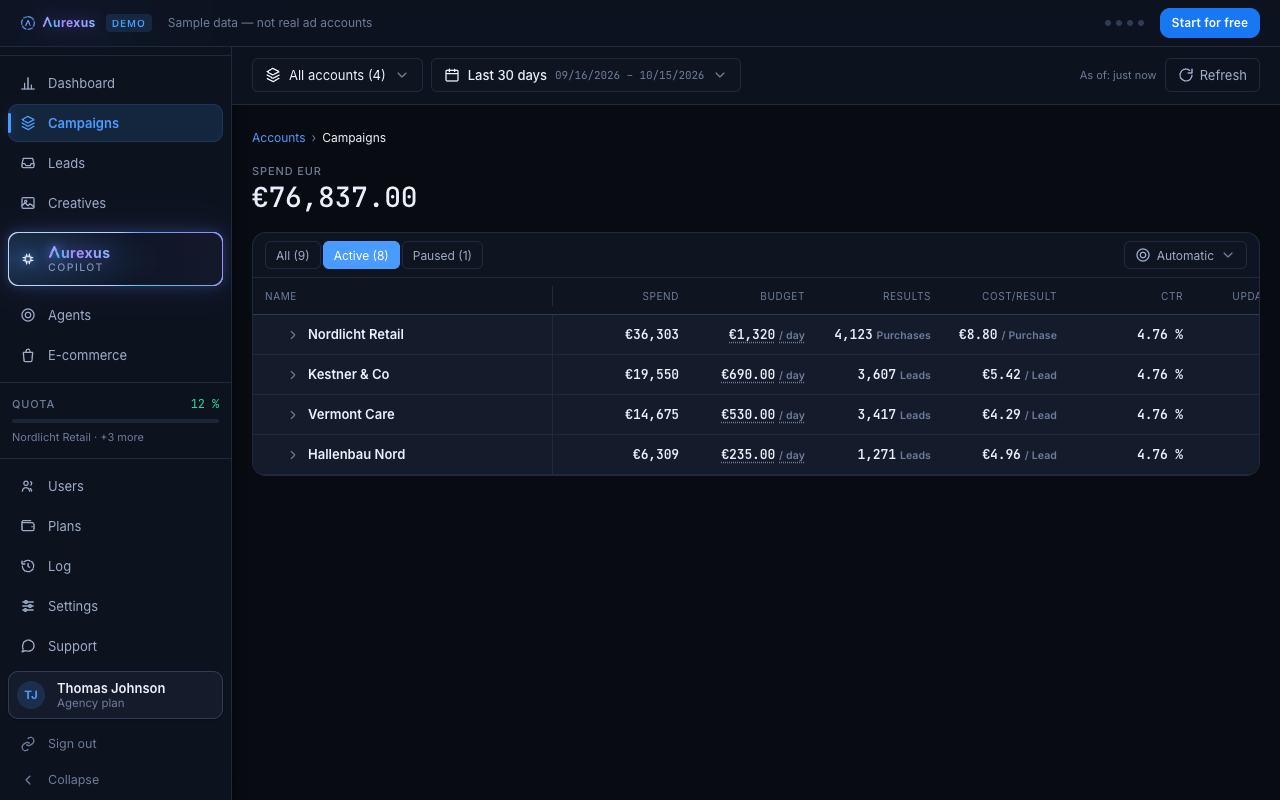
Once campaigns run, aurexus shows them as a tree across all your connected ad accounts: campaign › ad set › ad, down to the single ad. The copilot is part of the paid plans Pro and Agency. More on the AI copilot page.
Frequently asked questions
Which campaign objective should I choose?
The one that matches the business result you need: Sales for online purchases, Leads for contact requests, Traffic for visits, Awareness for reach, Engagement for interactions and App promotion for installs (Meta Business Help).
How do I run Meta ads step by step?
Choose the objective, decide whether the budget sits on the campaign or the ad sets, set audience, placements, budget and schedule in the ad set, then build the ad with format, creative and text. Add UTM parameters under Tracking and publish. Most ads are reviewed within 24 hours (Meta Business Help), then the learning phase starts.
What naming convention works for Meta ads?
One pattern per level that everybody on the team uses, for example objective, market, offer and month for campaigns, audience and placement for ad sets, and format, motif and version for ads. Name templates in Ads Manager apply the pattern automatically (Meta Business Help).
How many ad sets should a campaign have?
As many as your budget can feed with about 50 results a week each, and no more (Meta Business Help). As a check, divide the daily budget by target cost per result × 50 ÷ 7. Meta recommends combining similar ad sets rather than splitting them (Meta Business Help).